Why we start with business logic, not technology
Most AI projects that disappoint were technology choices made too early. Here is how we find the real problem first, and what that looks like in practice.
- By
- Nordic Labs X team · Strategy and engineering
- Published
- · 2 min read
Most AI projects that disappoint don't fail because the model was weak. They fail because someone picked a tool before anyone understood the work it was supposed to change.
So we start somewhere less exciting: with the people who do the work, the data they touch and the exceptions they handle every day. We call that the business logic.
What “business logic” actually means
Business logic is the set of rules, habits and judgement calls that make your company run. Some of it is written down. Most of it lives in people's heads.
For an order desk it might look like this:
- Orders arrive as PDFs in eleven different layouts.
- Every order must end up as the same six fields in the ERP.
- Delivery addresses for existing customers are already known.
- Anything unusual goes to Johan, because Johan knows the customer.
None of those points mention AI. But together they tell you exactly where AI helps (reading any layout) and where it must not decide alone (the unusual cases).
Three questions we ask before choosing any technology
- Where does the time actually go? We sit with the team and time real tasks, not estimates.
- What has to be true for the result to be correct? These become the validation rules.
- Who should decide when the system is unsure? This becomes the review step.
A good solution is mostly the answers to these three questions. The technology is the part that is easiest to change later.
What this looks like in a real project
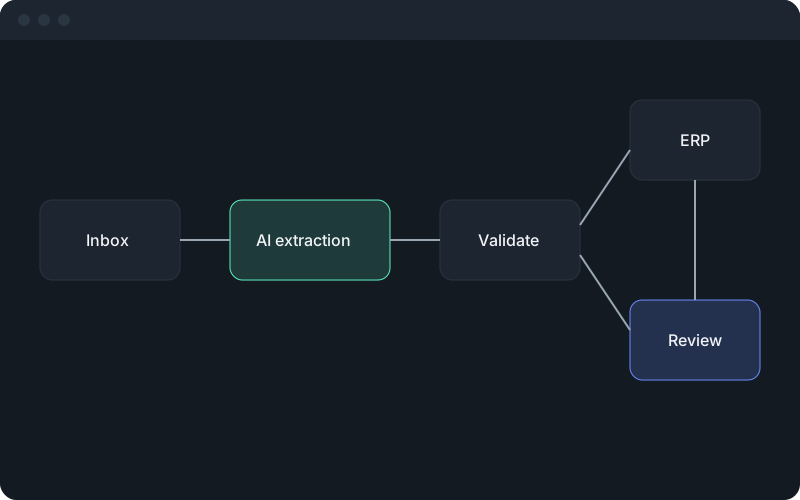
In our order handling case, the answers led to a simple design: AI reads the order, known customer data checks it, and a person approves only the uncertain ones.
| Before | After |
|---|---|
| 14 hours of typing per week | No manual typing |
| 23 address errors per month | 2 per month |
| Two people tied up twice a week | One quick review screen |
The model was the least interesting decision in the project. The review step was the most important one, because it is what made the team trust the system from day one.
How to try this yourself
You don't need us to start. Pick one repetitive task and write down:
- every system it touches,
- every rule someone checks by hand,
- every case that gets passed to a colleague.
If that list fits on one page, the task is probably a good first candidate for automation. If it doesn't, that is useful too: it tells you where the real complexity is before you spend money on it.
If you want a second pair of eyes on your list, book a free AI audit. We will tell you honestly whether AI is the right tool, even when the answer is no.
Related case study

14 hrs
saved every week
// next step
Recognise your own X in this? Let's talk.
Tell us the problem in your own words. We'll reply within one business day with a straight answer on whether we can solve it, and how.
Free · 30 minutes · no commitment